Cash vs Accrual Accounting: What’s the Difference?
Understand cash vs accrual accounting, how each method works and which is right for your business. Discover how QuickBooks Online can simplify bookkeeping.

When running a business, understanding how much money you earn and spend is essential. But did you know that the way you record your income and expenses can change how your business’s financial performance looks?
This is where cash accounting and accrual accounting come in.
Both methods help businesses keep track of their finances, but they work in different ways. Understanding the difference can help you make better financial decisions, manage your cash flow and get a clearer picture of how your business is performing.
Cash accounting is one of the simplest ways to record business income and expenses.
With this method, you record income when the money actually arrives in your bank account and expenses when you pay them. In other words, you only record transactions when money changes hands.
Cash accounting is relatively simple to understand and manage, as it records income and expenses when money actually enters or leaves the business bank account.
This makes it easier to monitor day-to-day cash flow and understand how much money is available at any given time. It also involves fewer timing adjustments, making it a straightforward option for many small businesses.
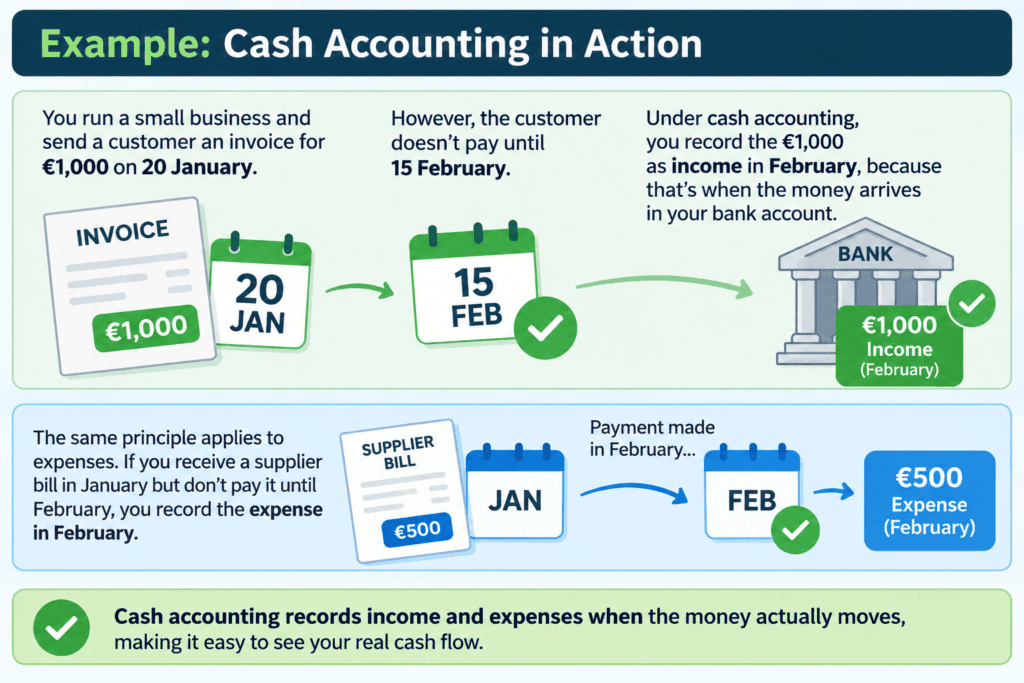
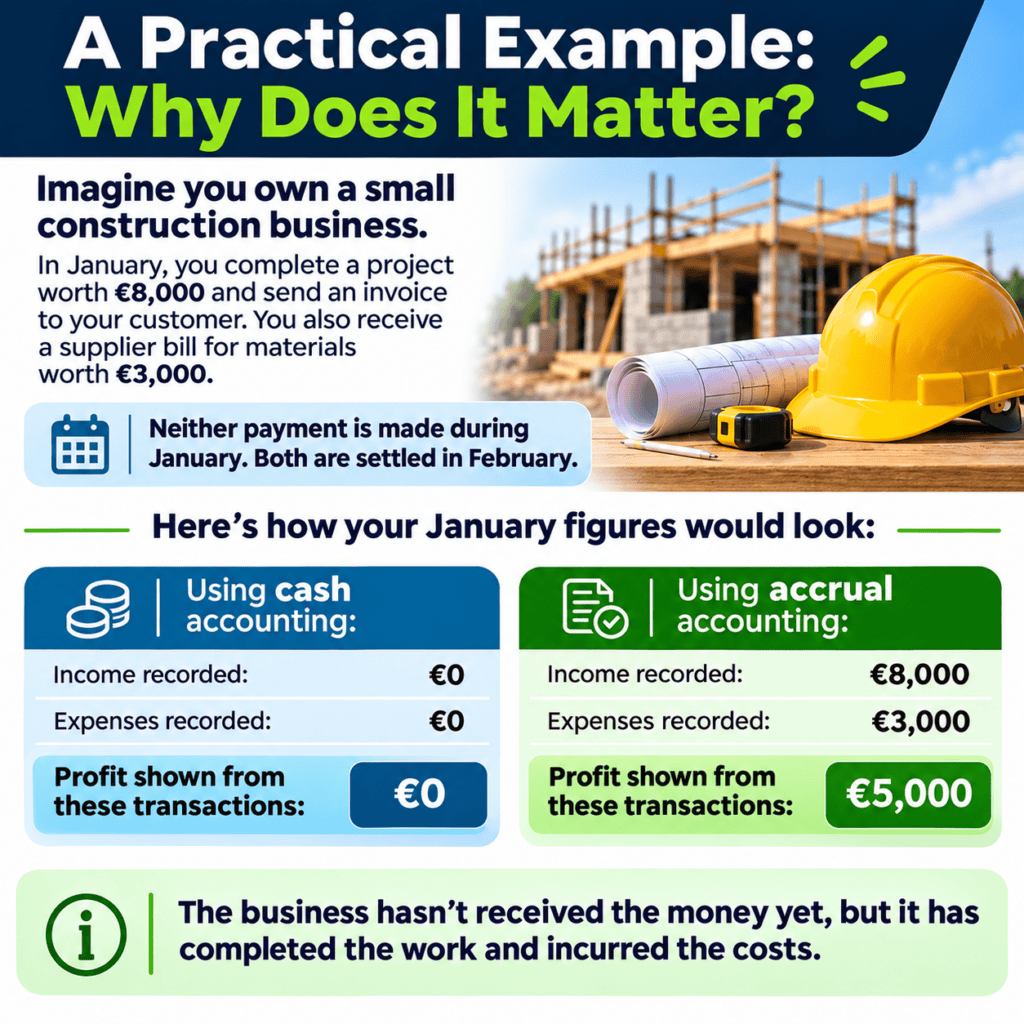
Pro tip: Cash accounting doesn’t always show the full financial picture of your business. You might have completed work worth thousands of Euros but not yet received payment. Your accounts won’t show that income until the customer pays.
Accrual accounting works differently. Instead of recording transactions when money changes hands, you record income when it is earned and expenses when they are incurred.
This means your accounts reflect business activity, even if the money hasn’t yet been received or paid.
Accrual accounting records income when earned and expenses when incurred, regardless of when money changes hands. It gives businesses a clearer picture of profitability by including outstanding invoices and unpaid bills, making it particularly useful for growing businesses.
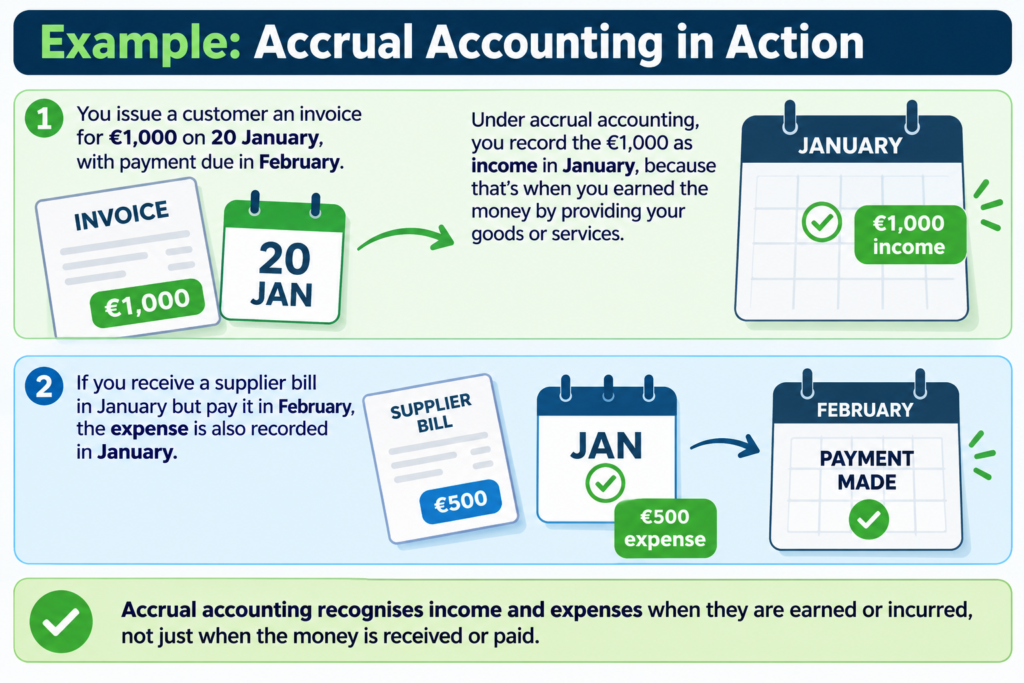
Pro tip: Accrual accounting can require a little more organisation, as you’ll need to keep track of outstanding invoices, unpaid bills and other financial commitments. However, it provides a clearer picture of your business’s financial performance.
The answer depends on how your business operates.
Cash accounting may suit businesses with straightforward transactions, fewer outstanding invoices and a strong focus on monitoring money received and payments made.
Accrual accounting may be particularly suitable for businesses that regularly invoice customers and offer payment terms or purchase goods and services from suppliers on credit. It can also be beneficial for businesses that manage stock or larger projects and want a clearer understanding of their profitability. As a business grows, accrual accounting provides more detailed financial information, helping owners make better-informed decisions and plan for future growth.
Pro tip: Certain businesses may have specific accounting and tax requirements. In Ireland, cash-basis accounting should not be confused with the VAT cash receipts basis, which has its own Revenue rules and eligibility criteria. Speak to your accountant about which approach is appropriate for your business.
Whichever method you use, having accurate and organised financial records makes running your business much easier.
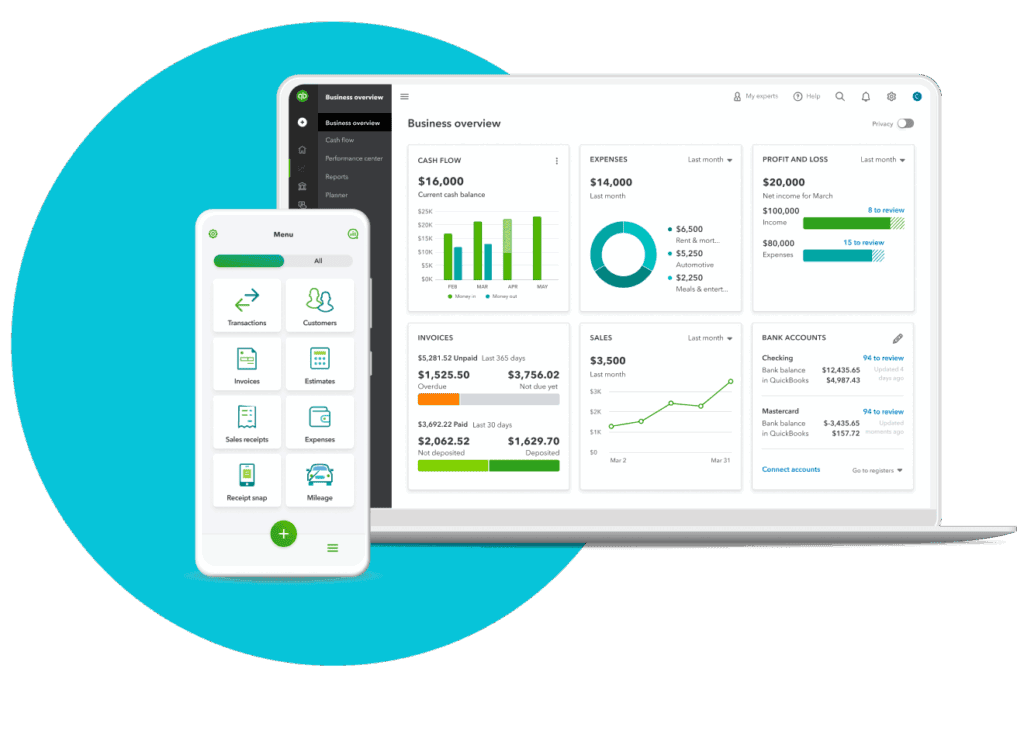
QuickBooks Online helps you manage your business finances in one place. You can create and track customer invoices, see which payments are outstanding, manage supplier bills and expenses, and match transactions with your bank account. You can also generate Profit and Loss reports using cash or accrual accounting, giving you a clearer picture of how your business is performing.
Instead of spending hours working through spreadsheets, you can access useful financial information and reports to help you make more informed decisions.
Cash and accrual accounting both have their place in business. Cash accounting helps you understand when money moves in and out of your bank account, while accrual accounting gives you a clearer picture of what your business earns and spends over time.
At Accountancy Software, we help Irish businesses get the most out of QuickBooks Online. From choosing the right subscription to setting up your accounts and learning how to use the software, our team is here to help.
Get in touch with us today to arrange a free consultation and discover how QuickBooks can make managing your business finances simpler.
Understand cash vs accrual accounting, how each method works and which is right for your business. Discover how QuickBooks Online can simplify bookkeeping.
Learn how to prepare your books with 7 practical steps to organise financial records, reconcile accounts and get your business ready for your accountant.
Follow these month-end bookkeeping tips to track cash flow, reconcile accounts, manage invoices and keep your business finances organised.
| Cookie | Duration | Description |
|---|---|---|
| cookielawinfo-checkbox-analytics | 11 months | This cookie is set by GDPR Cookie Consent plugin. The cookie is used to store the user consent for the cookies in the category "Analytics". |
| cookielawinfo-checkbox-functional | 11 months | The cookie is set by GDPR cookie consent to record the user consent for the cookies in the category "Functional". |
| cookielawinfo-checkbox-necessary | 11 months | This cookie is set by GDPR Cookie Consent plugin. The cookies is used to store the user consent for the cookies in the category "Necessary". |
| cookielawinfo-checkbox-others | 11 months | This cookie is set by GDPR Cookie Consent plugin. The cookie is used to store the user consent for the cookies in the category "Other. |
| cookielawinfo-checkbox-performance | 11 months | This cookie is set by GDPR Cookie Consent plugin. The cookie is used to store the user consent for the cookies in the category "Performance". |
| viewed_cookie_policy | 11 months | The cookie is set by the GDPR Cookie Consent plugin and is used to store whether or not user has consented to the use of cookies. It does not store any personal data. |