Bookkeeping Basics: A Guide for Small Businesses
Learn the bookkeeping basics for small businesses, from Profit & Loss and Balance Sheets to bank reconciliation, expenses and QuickBooks.

Bookkeeping is the process of recording, organising and maintaining your business’s financial transactions. It gives you a clear picture of your finances, helping you understand what money is coming in, where it is being spent and how your business is performing.
You don’t need to be an accountant to understand your business finances. Keeping your records accurate and up to date gives you the information you need to make informed decisions, manage your finances effectively and stay in control of your business.
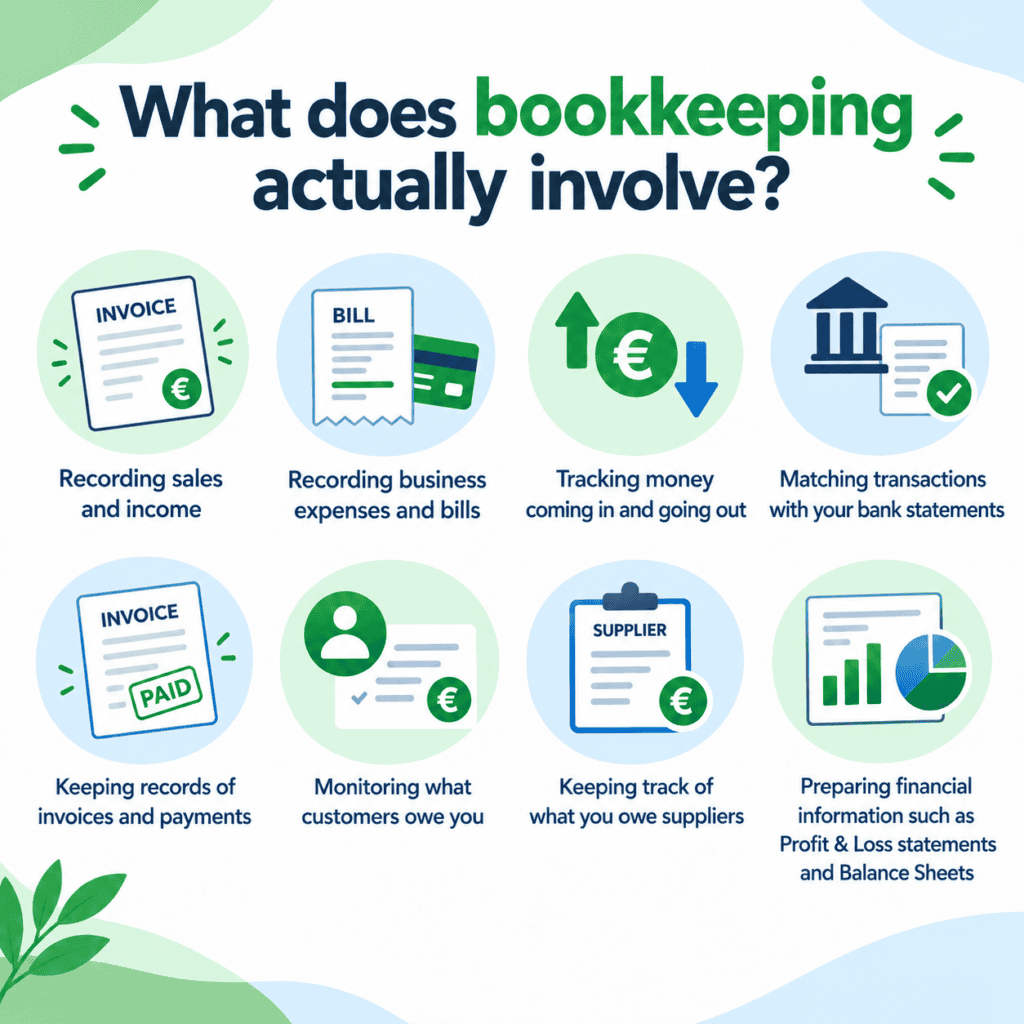
Bookkeeping covers the day-to-day financial activity of your business. This includes recording sales and expenses, managing invoices and payments, tracking money owed by customers and suppliers, reconciling bank transactions and preparing financial reports such as Profit & Loss statements and Balance Sheets.
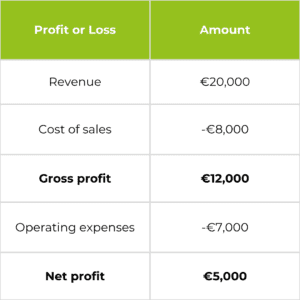
A Profit & Loss (P&L) Statement gives you a clear overview of your business’s financial performance over a set period. It shows your income, expenses and whether your business made a profit or a loss.
For example, if your business generated €20,000 in revenue and spent €8,000 on the direct costs of your products or services, you would have €12,000 in gross profit. After paying €7,000 in other operating expenses, your business would be left with a €5,000 net profit.
This gives you a much clearer picture of your business performance than simply looking at €20,000 in sales and assuming the business is doing well.
Pro tip: Your P&L shows how your business is performing, helping you understand costs, spot changes and make informed financial decisions.
While a Profit & Loss Statement shows how your business has performed over a period of time, a Balance Sheet gives you a snapshot of your business’s financial position at a specific point in time.
It shows what your business owns, what it owes and what is left for the owner. These are known as assets, liabilities and equity.
The basic accounting formula is:
Assets = Liabilities + Equity
Pro tip: This formula must always balance, which is where the name Balance Sheet comes from.
Assets are things your business owns or controls that have financial value. This can include money in your business bank account, cash, stock or inventory, equipment, vehicles, computers and other business property. It can also include money owed to you by customers.
Liabilities are amounts your business owes to other people or organisations. These can include business loans, credit cards, unpaid supplier bills, VAT or other taxes due, wages owed and other outstanding debts
Equity represents the owner’s financial interest in the business after its liabilities have been taken into account.
For example, if your business has €50,000 in assets and €20,000 in liabilities, the remaining €30,000 represents the owner’s equity in the business.
€50,000 = €20,000 + €30,000
Pro tip: Understanding your Balance Sheet alongside your Profit & Loss Statement gives you a clearer picture of both your business performance and its overall financial position.
Bank reconciliation involves comparing the transactions recorded in QuickBooks with your bank statement to make sure your records match your actual bank activity.
Regular reconciliation can help identify missing or duplicate transactions, incorrect amounts, bank fees and payments that have not yet cleared. Catching these issues early helps keep your accounts accurate and up to date.
Pro tip: Regular reconciliation gives you greater confidence in your business finances.
Keeping track of your expenses gives you a clearer picture of where your business is spending money and helps you manage costs more effectively.
Keep business and personal expenses separate and make sure each expense is correctly categorised in QuickBooks. It is also important to keep receipts and supplier invoices as supporting records.
Tools such as QuickBooks and AutoEntry can help you store these documents digitally, making it easier to keep your expenses organised.
QuickBooks can take the hassle out of everyday bookkeeping by bringing your banking, invoicing, expenses and financial reports together in one place.
Automate routine tasks, reduce manual data entry and keep your financial records organised and up to date. With the right setup, QuickBooks can make it easier to understand your finances and stay in control of your business.
Whether you are new to QuickBooks or looking to get more from the software, our team can help with setup, training and ongoing support.
Learn the bookkeeping basics for small businesses, from Profit & Loss and Balance Sheets to bank reconciliation, expenses and QuickBooks.
How much does bookkeeping cost in Ireland? Explore typical prices, what affects the cost and how QuickBooks Online could help reduce expenses.
Learn how to set up a chart of accounts in QuickBooks, import accounts from a spreadsheet and organise your accounts for accurate reporting.
| Cookie | Duration | Description |
|---|---|---|
| cookielawinfo-checkbox-analytics | 11 months | This cookie is set by GDPR Cookie Consent plugin. The cookie is used to store the user consent for the cookies in the category "Analytics". |
| cookielawinfo-checkbox-functional | 11 months | The cookie is set by GDPR cookie consent to record the user consent for the cookies in the category "Functional". |
| cookielawinfo-checkbox-necessary | 11 months | This cookie is set by GDPR Cookie Consent plugin. The cookies is used to store the user consent for the cookies in the category "Necessary". |
| cookielawinfo-checkbox-others | 11 months | This cookie is set by GDPR Cookie Consent plugin. The cookie is used to store the user consent for the cookies in the category "Other. |
| cookielawinfo-checkbox-performance | 11 months | This cookie is set by GDPR Cookie Consent plugin. The cookie is used to store the user consent for the cookies in the category "Performance". |
| viewed_cookie_policy | 11 months | The cookie is set by the GDPR Cookie Consent plugin and is used to store whether or not user has consented to the use of cookies. It does not store any personal data. |